Knuckling in Great Dane Puppies: Causes and Fixes
Contents
- What is the Root Cause of knuckling in Great Dane Puppies?
- Great Dane Health Issues and Orthopedic Growth Disorder
- What Does knuckling in Great Dane Puppies look like?
- How to Treat Great Dane Puppy knuckling?
- The Best Great Dane puppy Food to Treat knuckling
- What Does it mean when a Great Dane knuckles?
- Can I use Vitamin C to Treat knuckling?
- How Do you Fix knuckling in Great Dane Puppies?
- Anti-knuckling device works for Great Dane
- What are the Signs of Neurological Problems in Great Dane Puppies?
- How to Strengthen Weak Great Dane Puppy Feet?
- What is HOD in a Great Dane?
- FREQUENTLY ASKED QUESTIONS
- Why Does knuckling Happen in Dogs?
- Is knuckling over Genetic?
- What Causes a Puppy to be Bow-Legged?
- Does knuckling in Dogs go Away?
- What Does it mean when your Dog’s Front Legs give out?
- Conclusion
- Sources
Knuckling is fairly common in fast-growing Great Dane puppies. It is alarming to see your puppy’s front wrists buckle forward or its legs bow, but many mild cases improve with the right diet, footing and time.
The cause isn’t fully understood. It is linked to rapid growth, tendons and muscles that lag behind bone growth, unbalanced diets, too many calories, and slippery floors.
Sometimes called carpal laxity or carpal flexural deformity, it ranges from mild to severe. Because knuckling can also be a sign of nerve or bone disease, have your vet examine any puppy that starts knuckling.
What is the Root Cause of knuckling in Great Dane Puppies?
The exact cause isn’t known, but growing-puppy knuckling is commonly associated with:
- Feeding a diet that isn’t complete and balanced for large-breed growth.
- Mixing diets, such as kibble plus home-cooked food, which can unbalance minerals.
- Adding calcium, vitamin or mineral supplements to a complete puppy food.
- Too many calories, leading to growth that is too fast.
- Home-cooked or raw diets that haven’t been formulated by a board-certified veterinary nutritionist.
- An incorrect balance of calcium and phosphorus.
- Hard, slick floors that give poor footing.
- Long nails, which change how the foot lands.
- Too little, or too much and too intense, exercise.
Great Dane Health Issues and Orthopedic Growth Disorder
Great Dane puppies grow very fast, and their growth plates are large and easy to feel at the wrists. Hot, swollen or painful growth plates are not normal, so see your vet. Watch for whining, limping, reluctance to move, a strange gait, or wobbling, as well as flat or turned-out feet.
Some common growth disorders in Great Dane puppies are:
Injury: If a growth plate is injured, the bone can grow unevenly. The Merck Veterinary Manual notes this can cause angular limb deformities and lameness that may need surgery.
HOD: Hypertrophic osteodystrophy is a painful disorder of the growth areas of the long bones in young large and giant breeds. Merck lists pain and swelling near the wrists, fever, loss of appetite and depression.
Panosteitis: This is bone inflammation in young, rapidly growing large-breed dogs. It causes lameness and pain that may come and go, and Merck notes it lasts only as long as the dog is growing.
What Does knuckling in Great Dane Puppies look like?
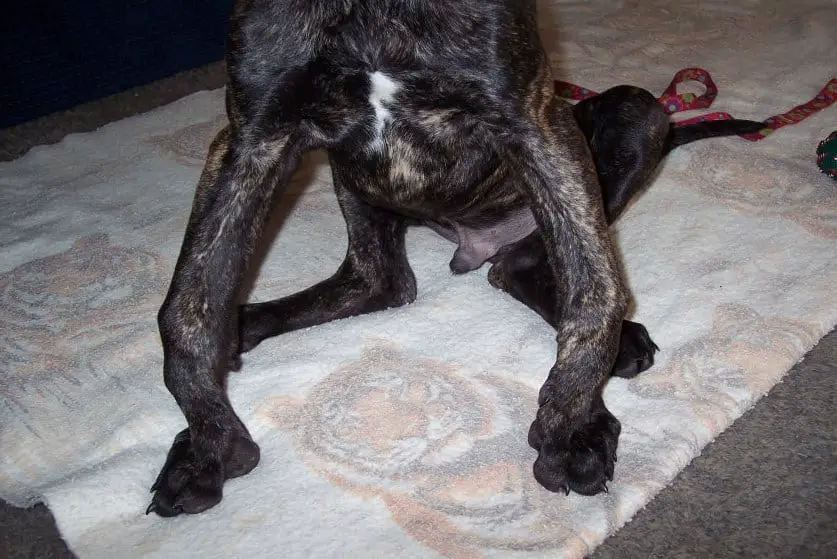
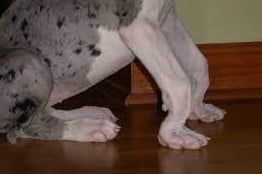
The front wrists (carpi) bend forward, so the legs look bowed or buckled from the side, and the puppy may look like it is struggling to hold its weight. In mild cases the wrists only wobble forward; in severe cases the puppy may bear weight on the front of its wrists. See your veterinarian as soon as possible.
How to Treat Great Dane Puppy knuckling?
Treatment starts with a vet exam to confirm it is growth-related knuckling and not a bone, joint or nerve problem. The vet may take x-rays, and nerve problems sometimes need advanced imaging such as a CT or MRI.
For typical growth-related knuckling, vets usually recommend switching to a complete and balanced large-breed puppy food, stopping supplements, keeping the puppy lean, trimming nails, and providing good footing. Controlled, gentle exercise helps the tendons and muscles catch up. Severe or persistent cases may need splints, bandages or other treatment from your vet.
The Best Great Dane puppy Food to Treat knuckling
Choose a puppy food whose label says it is complete and balanced for growth of large-size dogs (70 pounds or more as adults). These diets control calories and calcium for giant breeds.
Don’t add calcium or other supplements. Merck notes that giant-breed dogs fed excess calcium are more likely to develop growth disorders such as osteochondrosis and hypertrophic osteodystrophy. Ask your vet to help you pick a food and the right daily amount.
What Does it mean when a Great Dane knuckles?
It usually means the tendons, ligaments and muscles of the front legs aren’t keeping up with the puppy’s rapid bone growth. The wrists can’t stay straight under the puppy’s weight and buckle forward.
Can I use Vitamin C to Treat knuckling?
There is no good evidence that vitamin C treats knuckling. Dogs make their own vitamin C, and extra vitamin C can cause loose stools and diarrhea.
Ask your vet before giving any supplement to a growing giant-breed puppy. Correcting the diet, footing and exercise matters far more.
How Do you Fix knuckling in Great Dane Puppies?
Work with your vet, and fix the diet first. These other steps can also help:
- Use only reward-based training, without physical force or harsh leash corrections.
- Don’t add supplements unless your vet recommends them.
- Keep walks short and on soft, even ground; avoid long or forced runs.
- Keep the nails trimmed short; many owners trim every one to two weeks.
- Don’t let the puppy jump on and off furniture or out of vehicles.
- Switch to a complete large-breed puppy food if you aren’t using one.
- Put down rugs or runners so the puppy has non-slip footing.
- Give your puppy a supportive bed.
- Wait to jog or run with your dog until it is done growing; ask your vet when that is.
- Limit long hours in a crate, which reduces normal movement.
- Allow free play on safe, varied, non-slip surfaces like grass.
- Tell your breeder; they may know of similar issues in the line.
Anti-knuckling device works for Great Dane
What are the Signs of Neurological Problems in Great Dane Puppies?
Signs that point to a nerve or spinal problem rather than growth-related knuckling include poor balance, disorientation, weakness or wobbling in the hind legs, seizures, neck or back pain, abnormal eye movements and confusion.
Knuckling of the toes, where the dog scuffs or stands on the top of its paw, is also a neurologic sign. If you see these, see your vet promptly.
How to Strengthen Weak Great Dane Puppy Feet?
Ask your vet or a veterinary rehabilitation therapist before starting exercises. Gentle options they may suggest include:
- Short, slow walks up and down gentle slopes.
- Standing with the front feet on a cushion or balance disc for a few seconds at a time.
- Walking at a relaxed pace instead of constant heel position.
- Free play on grass, sand or pea gravel.
- Brief, supervised balance games on a soft surface.
- Non-slip flooring indoors.
- A safe play area where the puppy can explore at its own pace.
What is HOD in a Great Dane?
HOD stands for hypertrophic osteodystrophy. According to the Merck Veterinary Manual, it is a developmental disorder of the long bones in young, growing dogs, usually large or giant breeds. The exact cause is unknown, and treatment focuses on pain relief prescribed by a vet.
FREQUENTLY ASKED QUESTIONS
Why Does knuckling Happen in Dogs?
In puppies, knuckling of the wrists is usually a growth problem.
In adult dogs, knuckling of the paws often comes from nerve or spinal disease, such as degenerative myelopathy, nerve damage, spinal tumors, intervertebral disc disease, cervical spondylomyelopathy (wobbler syndrome), fibrocartilaginous embolism, and cauda equina syndrome. Intervertebral disc disease is a bulging or ruptured disc between the bones of the spine.
Is knuckling over Genetic?
It isn’t clear. Diet, calories, growth rate and environment play a large role. Genetics may influence how fast a puppy grows and how prone it is to growth disorders.
What Causes a Puppy to be Bow-Legged?
Fast-growing giant-breed puppies put a lot of stress on their growing bones and soft tissues. Unbalanced diets, injury to a growth plate, or uneven growth of the two forearm bones can cause the legs to bow, so have your vet check it.
Does knuckling in Dogs go Away?
Mild growth-related knuckling often improves within weeks once the diet, footing and exercise are corrected. Severe cases may need splints or other treatment. Knuckling caused by nerve or spinal disease depends on the cause and may need lifelong management.
What Does it mean when your Dog’s Front Legs give out?
Front legs that give out can come from many problems, including neck disc disease, wobbler syndrome, nerve injury, joint disease or muscle weakness. Brachial plexus avulsion is a nerve injury, usually from trauma such as a car accident, that can cause a front leg to go limp. Any dog whose legs give out needs a vet exam.
Conclusion
This article is for general information and isn’t a substitute for a veterinary exam. If your Great Dane puppy is knuckling, see your veterinarian.
If you found this article helpful, share it with your friends.
Checkout Our these Guides:
- 5 Steps About Caring For A Great Dane Puppy
- What To Feed A Great Dane Puppies
- How Much Does Great Dane Weigh
- 8 Best Dog Food For Great Danes With Skin Allergies
- 6 Best Wet Dog Food For Great Danes
Sources
- Bone Disorders in Dogs, Merck Veterinary Manual
- Disorders Associated with Calcium, Phosphorus, and Vitamin D in Dogs, Merck Veterinary Manual
- Developmental Osteopathies in Dogs and Cats, Merck Veterinary Manual