Why Does My Horse Not Want to Canter?

Contents
- Top Reasons Why Does My Horse Not Want to Canter?
- Not Properly Conditioned:
- Carrying Too Much Weight:
- Lack of Correct Aids:
- Pain or a Physical Problem:
- How do I get my horse to canter?
- Start with the Basics:
- Don't Canter While Bouncing
- Use the Correct Aids:
- Be Patient:
- FAQs
- What is a typical canter speed?
- What is the difference between a canter and a trot?
- Conclusion:
- Sources
Whether you're just starting out with horseback riding or have been doing it for years, eventually you'll want to canter your horse. If your horse just won't pick up the gait, there are a few common causes to work through.
A horse that refuses to canter is most often in pain, not fit enough, or confused by unclear aids. Have a vet rule out lameness, back pain and poor saddle fit first. Then build fitness and use clear, consistent canter cues.
Top Reasons Why Does My Horse Not Want to Canter?
There are a few reasons why your horse might not want to canter.
Not Properly Conditioned:
One possibility is that your horse isn't fit enough yet. Cantering takes more effort than walking and trotting, so an unfit horse may need more conditioning work first.
Carrying Too Much Weight:
Another possibility is that your horse is carrying too much weight, from excess body fat or a rider and tack that are too heavy for its build.
Talk to your veterinarian or trainer about a safe plan to get your horse in shape.
Lack of Correct Aids:
Another possibility is that you're not giving a clear cue. If your aids are mixed or inconsistent, your horse won't understand what you're asking.
A common canter cue is to sit deep in the saddle (not post), keep your inside leg at the girth, and apply your outside leg just behind the girth. Keep a light, steady contact; if you pull on the reins at the same time, you are telling the horse to slow down.
Pain or a Physical Problem:
This is the reason to check first, not last. Sore backs, poorly fitting saddles and hind-limb or hoof pain often show up as resistance in the canter.
The Merck Veterinary Manual lists resistance to lead changes as an early warning sign of pain. If your horse suddenly refuses, bucks or kicks out at the canter, ask your veterinarian for a lameness exam.
How do I get my horse to canter?
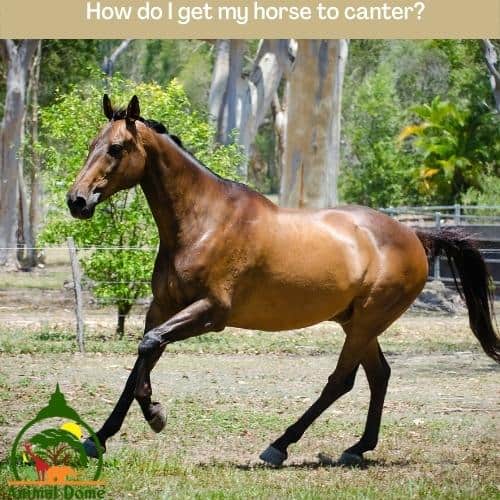
Once pain has been ruled out, these steps can help.
Start with the Basics:
If you're new to riding, or it's been a while, get comfortable with trotting and with walk, trot and halt transitions before trying to canter.
According to Robyn Volkening who is a lifelong equestrian with 38 years on the saddle, "The easiest way for a beginner to canter/lope (western, same thing-different tack) a horse is to learn on a very experienced, calm horse that knows his job. A smooth mover that goes into the gait easily and doesn't immediately stop or lunge forward is the best to learn on. In an enclosed, safe arena without much other activity to steer around, exercise the horse first so it is not excited."
Robyn continues: "Lunge or ride the horse at the walk and trot first, doing exercises ahead of time to gauge the mood. Don't attempt to canter if the horse is excited or distracted."
Then, on a circle, look up, sit back, squeeze with the outside leg, kiss to the horse, and sort of scoop forward with your outside leg. Leave your hands still on a looser rein, don't balance on their mouth.
Don't Canter While Bouncing
Robyn also suggests: "Canter without bouncing: make sure your stirrups are adjusted correctly with a good bend in your knee (not too long), heels down, weight in your stirrups, sit deep, keep your legs on, and feel your weight go out of your heels. Make sure to look up, not down, and don't balance on your hands/reins. Riding is active, not passive, you need to "hold" the horse with your legs and core contracted, and go with the movement, not sit too rigid or too sloppy."
Sit tall in the middle of the saddle with your weight even. Leaning forward or tipping to one side can unbalance the horse and make the transition harder.
"Once you're in the correct position, you'll need to give the horse a cue to canter. This can be done by using your legs to push down on the horse's sides, or by using your heels to flick the horse's sides. You can also use a crop or a verbal cue, such as saying "canter", says Laura Helke of WREI.
Once the horse is cantering, stay balanced in the middle of the saddle and follow the motion with your seat. Be ready to steady the horse if it rushes.
Use the Correct Aids:
Use the same cue every time: sit, inside leg at the girth, outside leg slightly behind it, and a soft, steady rein.
A Canter is a smooth gait, and one of the goals when cantering a horse is to maintain this smoothness. One way to do this is by using your bodyweight to help "steer" the horse. For example, if you want to go to the left, lean your body to the left.
Kara Dehoy CMO or Startups Anonymous
Any weight shift should be small. Leaning hard into a turn can unbalance your horse.
If you're not sure how to do this, ask a qualified instructor for help.
Be Patient:
Every horse learns at its own pace. Keep sessions short and positive, and stop on a good transition.
FAQs
What is a typical canter speed?
There is no single canter speed. A canter is usually faster than a trot and slower than a gallop, but a collected canter can be very slow and a big-striding horse can trot faster than a small horse canters.
What is the difference between a canter and a trot?
A canter is a three-beat gait while a trot is a two-beat gait. The canter also has a lead: on a circle, the inside foreleg reaches farther forward.
You can ask the horse to lengthen its canter or shorten it into a slow, collected canter.
Conclusion:
Most horses that won't canter are sore, unfit or unsure of the cue. Rule out pain with your vet, then build fitness and keep your aids clear and consistent.
Sources
- Overview of Lameness in Horses, Merck Veterinary Manual