Can Horses Eat Plums?
Contents
Ok continuing on my ‘what can horses eat’ series. As a horse owner, you might want to know if your horse can eat plums and if these will cause any health issues good or bad.
Horses can eat a small amount of ripe plum flesh as an occasional treat, but only with the pit (stone) removed. The ASPCA lists plum as toxic to horses because the stems, leaves and seeds contain cyanide-producing compounds.
Never let a horse eat whole plums, fallen fruit with pits, or plum tree leaves and branches.
In this article, we are going to cover what plums offer a horse, the parts to avoid, and how to feed them safely.
Is It Healthy For Horses to Eat Plums?
Plum flesh contains some fiber, vitamin C and antioxidants, but a horse gets what it needs from good forage and a balanced ration. Plums are a treat, not a source of nutrition.
Horses are herbivores whose digestive system is built around eating forage for most of the day. Hay and pasture, not fruit, supply the fiber that keeps the gut working.
Fruit is high in sugar. Keep treats small, and check with your vet before feeding any fruit to a horse with insulin resistance, PPID (Cushing's disease) or a history of laminitis.
The danger with plums is the pit. Plum, cherry, peach and apricot seeds contain cyanogenic glycosides, and the ASPCA lists signs of poisoning such as brick-red gums, dilated pupils, difficulty breathing, panting and shock.
The Merck Veterinary Manual notes that seeds and leaves usually carry the most cyanide potential, while the fleshy part of fruit generally has low levels. A pit is also a choking hazard.
If your horse gets into fallen plums, wilting leaves or cut branches, call your vet or the ASPCA Animal Poison Control Center right away.
Can I Feed Cooked Plums to my Horse?
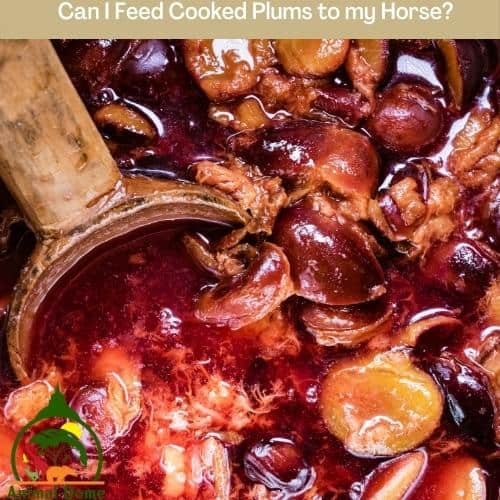
Plain cooked plum flesh with the pits removed is fine in small amounts, but there's no benefit to cooking it.
If you do cook plums, don't add any sugar or other sweeteners. Horses have a sensitive digestive system and too much sugar can cause problems.
Never feed your horse spoiled, moldy or fermenting plums.
Can I Feed Raw Plums to my Horse?
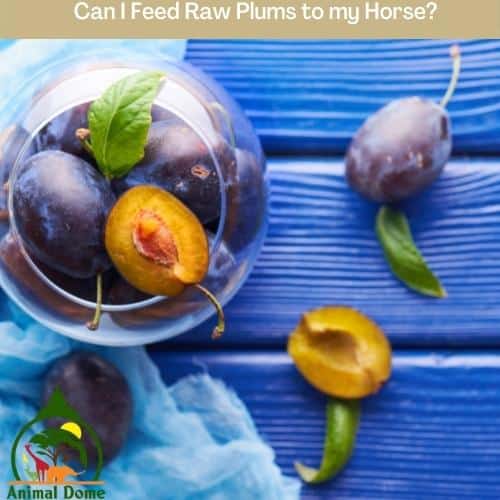
Yes, raw plums are fine as a treat as long as they are ripe, fresh and pitted. Cut them into slices so your horse can't gulp a large piece.
Introduce any new treat slowly and give only a slice or two at a time. Never feed spoiled or rotten plums, and keep horses out of orchards where pits and wilted leaves collect on the ground.
When Is the Best Time to Feed Plums to my Horse?
There's no special time of day. Give plums as a small treat alongside your horse's normal hay and feed routine, not as a replacement for it.
Can Horses Eat Any Type of Fruit?
Many fruits, such as apples, bananas and watermelon, are safe treats for horses in small amounts with the seeds and pits removed. Stone fruits like plums, cherries, peaches and apricots are safe only when the pit is removed. Here is a good video from a horse vet explaining which fruits and vegetables are safe:
Conclusion
Horses can enjoy a few slices of ripe, pitted plum as an occasional treat. The pits, leaves and stems are the dangerous parts, so never feed whole plums or let your horse graze under a plum tree.
If your horse has a metabolic condition or you're unsure about a treat, ask your vet first. Thanks for reading.
Sources
- Toxic and Non-Toxic Plants: Plum, ASPCA Animal Poison Control
- Cyanide Poisoning in Animals, Merck Veterinary Manual