Why Do Crocodiles Not Eat Other Crocodiles? The Truth!
Contents
Crocodiles are powerful predators of rivers, lakes and coastal waters. They will take almost any animal they can overpower, so it's natural to wonder whether they eat each other.
The short answer is that they sometimes do, but mostly when the other crocodile is much smaller.
Why don't crocodiles eat other crocodiles more often? Adult crocodiles rarely eat crocodiles of similar size because attacking one is dangerous and can cause serious injuries. Larger crocodiles do sometimes kill and eat much smaller ones, especially hatchlings and juveniles.
Do Crocodiles Eat Other Crocodiles?
Yes, cannibalism happens in crocodiles, but it mostly targets the young. The Smithsonian's National Zoo notes that many hatchlings never reach adulthood because predators eat eggs and young, and that more mature Cuban crocodiles have been reported eating young crocodiles.
A fight between two large adults is risky for both. Even the winner can be badly hurt, so equally matched crocodiles usually settle disputes with threat displays rather than fights to the death.
Crocodiles are territorial, especially large males. A big crocodile may attack a smaller one that enters its area, and it may eat a small rival it kills.
Food shortages can make cannibalism more likely, because a smaller crocodile becomes an easy meal for a hungry larger one.
Why Do Crocodiles Bite Off Each Other's Limbs?
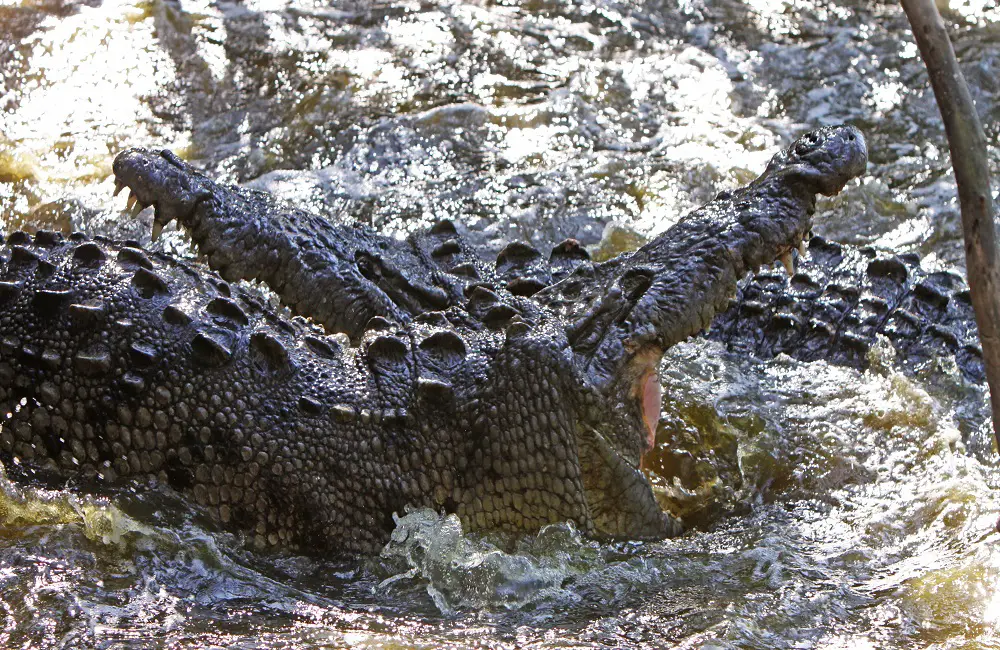
Missing limbs and tails are usually the result of fights with other crocodiles over territory, mates or food. Crocodiles grab and twist when they bite, which can tear off a leg or part of a tail.
Crocodiles can survive these injuries. Many wild crocodiles live for years with missing limbs, partial tails or other old wounds, and they can still swim, hunt and defend their territory.
What Do Crocodiles Eat?
Crocodiles are carnivores. Depending on their size and species, they eat fish, crustaceans, birds, reptiles and mammals. Young crocodiles eat insects, small fish and frogs, then take larger prey as they grow.
Large crocodiles may also eat smaller crocodiles, as described above.
What Did Ancient Crocodiles Eat?
Some ancient relatives of crocodiles ate plants. A 2019 study from the Natural History Museum of Utah at the University of Utah examined fossil teeth and found that complex, plant-suited teeth evolved in extinct crocodyliforms at least three separate times.
Other extinct relatives had teeth suited to crushing hard-shelled prey, and many were carnivores like today's crocodilians. All living crocodilians are carnivores.
Can A Crocodile Kill An Alligator?
A large crocodile could kill an alligator, and crocodiles have some of the strongest bites ever measured. In a study published in PLOS ONE, one saltwater crocodile produced a bite force of about 3,689 pounds (16,414 newtons), the highest bite force measured in any living animal at the time.
American alligators also have very strong bites, though lower than the largest crocodiles.
In practice, the two rarely meet. South Florida is the only place where wild American crocodiles and American alligators live side by side.
Can A Crocodile Kill A Hippopotamus?
Hippos and crocodiles share rivers and lakes in Africa. Adult hippos are huge and aggressive, and crocodiles are afraid of hippos for good reason.
A large crocodile may take a very young hippo calf if it gets the chance. A full-grown hippo is far too big and dangerous for a crocodile to tackle, and hippos have been seen attacking crocodiles.
Do Crocodiles Eat Their Offspring?
In the wild, female crocodiles of many species guard their nests and help their hatchlings reach the water. This protection is important, because many predators eat crocodile eggs and young.
Adult crocodiles other than the mother, including large males, may eat hatchlings and juveniles. In zoos and breeding programs, keepers often move eggs to incubators to protect them.
Do Crocodiles Feel Pain?
Crocodiles can feel pain. Like other reptiles, they have the nerves and brain structures to detect harmful stimuli, so they don't belong among animals that cannot feel pain.
They are good at hiding it, though. A crocodile's body language changes very little, so pain can be hard to spot without obvious wounds.
Final Thoughts
Crocodiles do eat other crocodiles, but mainly smaller ones, especially hatchlings and juveniles. Fights between large adults are dangerous, so they are usually avoided or settled with displays.
When large crocodiles do fight over territory, the results can include lost limbs and tails, and the loser may become a meal.
Sources
- Cuban Crocodile, Smithsonian's National Zoo and Conservation Biology Institute
- Insights into the Ecology and Evolutionary Success of Crocodilians Revealed through Bite-Force and Tooth-Pressure Experimentation, PLOS ONE
- Not a bunch of 'croc', University of Utah