Ferret Colors and Patterns
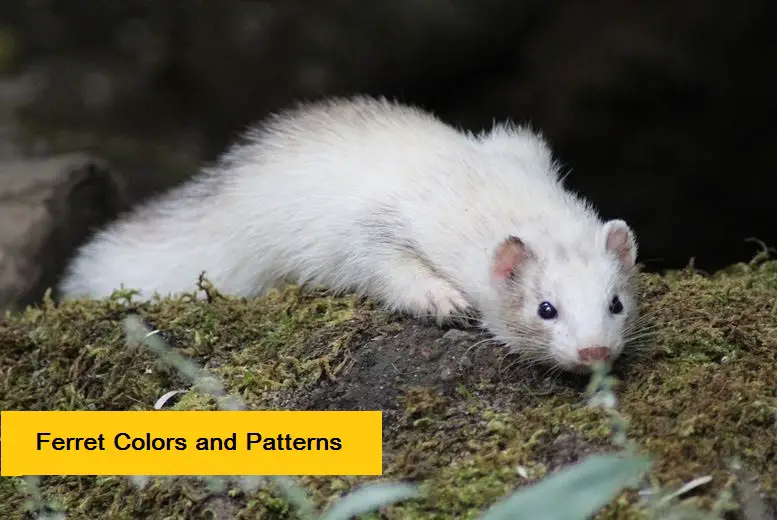
Ferrets come in a range of colors, and knowing the correct terms helps if you plan to enter your pet in a show. The American Ferret Association (AFA) describes a ferret's appearance by its color and pattern.
Color refers to the color of the guard hairs, undercoat, eyes and nose. Pattern describes how that color is concentrated and distributed on the body, mask and nose, and can also include white markings on the head or feet.
The AFA color standards list eight colors: Albino, Black, Black Sable, Champagne, Chocolate, Cinnamon, Dark-eyed White and Sable. Find the description that fits your ferret:
Albino is an absence of pigment, so the guard hairs and undercoat are white to cream (white preferred) with no pattern. The eyes are ruby red and the nose is pink.
Black describes ferrets with true black guard hairs and a white undercoat, though a slight golden hue is acceptable. The eyes and nose are black or near black, and a speckled black nose is acceptable.
Black Sable guard hairs are a dark ash blackish brown with no warm brown tone. The preferred undercoat is white to cream, not yellow. The eyes are dark brown or near black, and the nose is ash blackish brown; a mottled or heavily speckled nose is acceptable.
Chocolate ferrets have warm milk chocolate brown guard hairs. A white undercoat is preferred, but a slight golden hue is acceptable. Brown eyes are preferred and dark burgundy is acceptable. The nose is preferably pink, beige or pink with a light brown 'T' outline, and a brick-colored nose is acceptable.
Champagne is a tan, diluted version of Chocolate. The preferred undercoat is white to cream, not yellow. The eyes are light to dark burgundy, and the nose is preferably beige, pink or pink with a beige or light brown 'T' outline.
Cinnamon ferrets have rich light reddish brown guard hairs. That strong reddish cast sets them apart from Champagnes, and the AFA notes Cinnamons are less common.
A golden undercoat is preferred, but white is acceptable. The eyes are light to dark burgundy. The nose is preferably brick colored, or beige or pink with a light brown or brick 'T' outline; plain pink is allowed but not preferred.
Dark-eyed White (DEW) ferrets are white to cream but are not albino. Their eyes are burgundy and their noses are pink.
Sable is the most familiar ferret color. Sables have warm deep brown guard hairs and a white to cream or light golden undercoat (not yellow). The eyes are brown or near black, and the nose is preferably light brown, speckled or mottled brown, or has a brown 'T' outline.
Color can also shift with the seasons. The Merck Veterinary Manual notes a ferret's coat darkens and thickens in winter, then lightens and sheds in summer.
Interesting Reads: How to Keep Ferrets as Pets
Ferrets are not always evenly colored, so a full description also includes color concentration. A Solid ferret has close to 100% colored guard hairs. A Standard has about 90% to 100% colored guard hairs, but the body looks lighter and the legs and tail stand out.
Roans have 50% to 60% colored guard hairs and 40% to 50% white. Point (Siamese) ferrets show a clear contrast between a lighter body and darker points, usually with a thin 'V' mask. Each pattern also comes with its own mask and nose descriptions.
Ferret Patterns
Ferrets exhibit many different patterns and these have been classified and make up an important consideration in show animals.
The color of the legs and tail, together called the points, and how they compare with the body color are the main considerations when classifying a pattern. The AFA's color concentration patterns are Solid, Standard, Roan and Point (Siamese), and its white-marking patterns include Blaze, Panda and Mitts.
For example, in a Solid ferret the guard hairs are ideally 100% colored, so the body looks evenly colored from head to tail. A Blaze has a long white stripe from the forehead down the back of the neck, while a Panda has an almost completely white head with mitts on all four feet.
Sources
- AFA Ferret Color and Pattern Standards, American Ferret Association
- Description and Physical Characteristics of Ferrets, Merck Veterinary Manual